Clicks Show Where the Journey Ended. Measurement Shows What Drove It.
Ask three ad platforms how a campaign performed and you will get three confident answers. Ask finance and you will get a fourth.
Each platform reports honestly by its own rules. Each one also takes credit for any conversion it was near. Add those claims together and the total can easily exceed the sales the brand actually booked. Budgets then move on numbers nobody fully trusts.
This is the everyday reality of media measurement. Campaigns now run across connected TV, audio, digital out-of-home, display and social. A shopper sees a CTV spot on Sunday, hears a podcast ad on Tuesday, passes a screen near the grocery store on Thursday and buys in store the following week. Most reporting sees the last click, if there was one. Everything that built the sale goes uncounted.
What measurement should actually answer
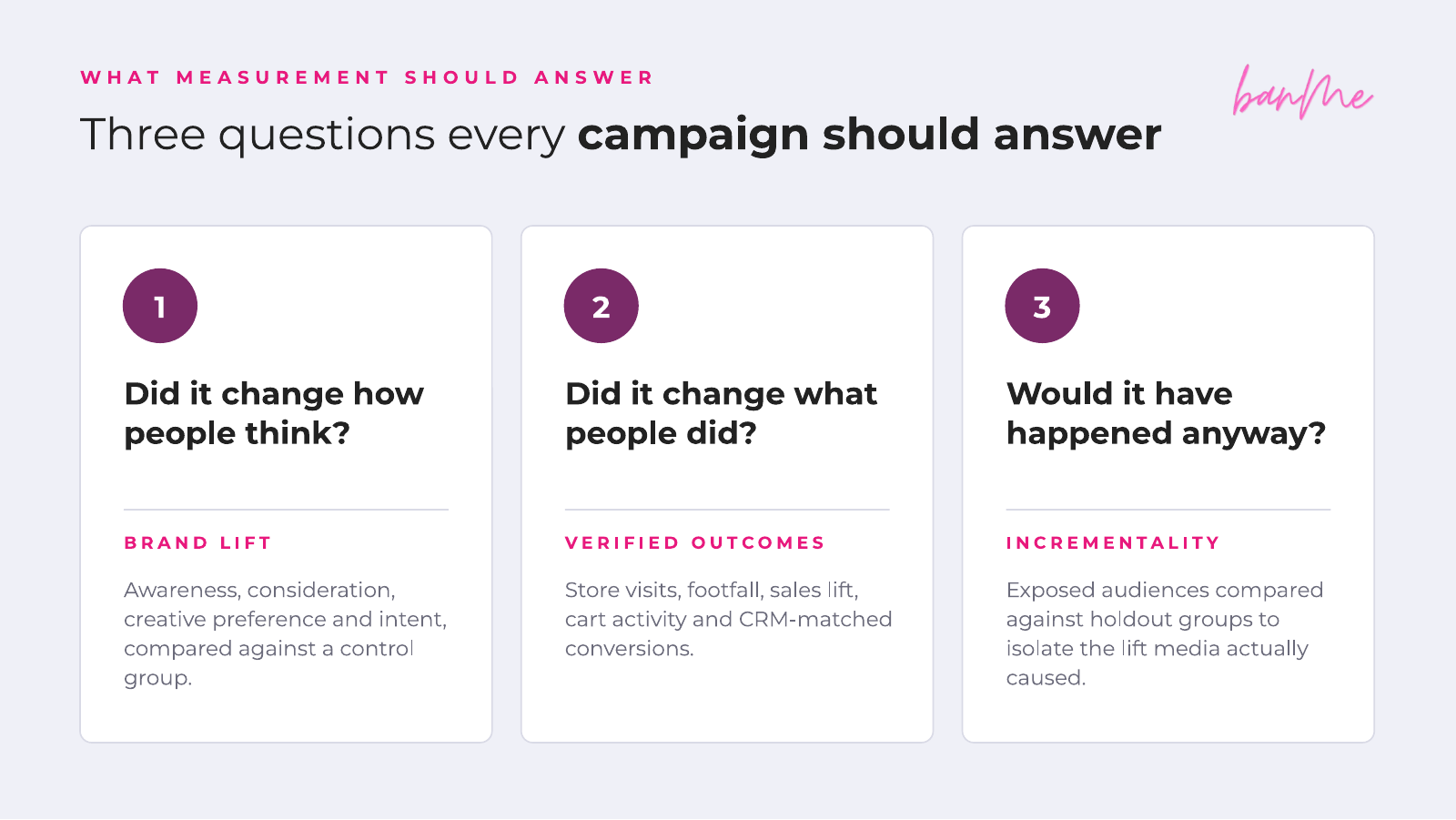
Good measurement comes down to three questions.
Did it change how people think? Awareness, consideration, preference and intent.
Did it change what people did? Visits, purchases, cart activity and sales.
Would it have happened anyway? The share of results the media actually caused.
A reporting dashboard can describe activity. A measurement program answers those three questions and uses the answers to plan the next campaign. That second part is where most of the value sits.
Why it got harder
Signal loss. Third-party cookies no longer work as the backbone of digital tracking. Fewer people can be followed across sites and devices. Conversions still happen. The touchpoints that led to them go dark, and attribution models start handing credit to whatever is still visible.
More screens, longer paths. CTV, audio and DOOH rarely produce a click. Offline sales often land after the reporting window closes. A click-based model has nothing to work with in either case.
Everyone grades their own work. Walled gardens report inside their own walls. The same conversion gets claimed two or three times, and no single platform can see the full path.
The industry feels it. The IAB's State of Data 2026 report found that roughly three in four marketers say their current mix of attribution, incrementality testing and marketing mix modeling falls short on speed, accuracy or trust. The methods are well understood. The data underneath them has thinned out.
Every channel measures differently
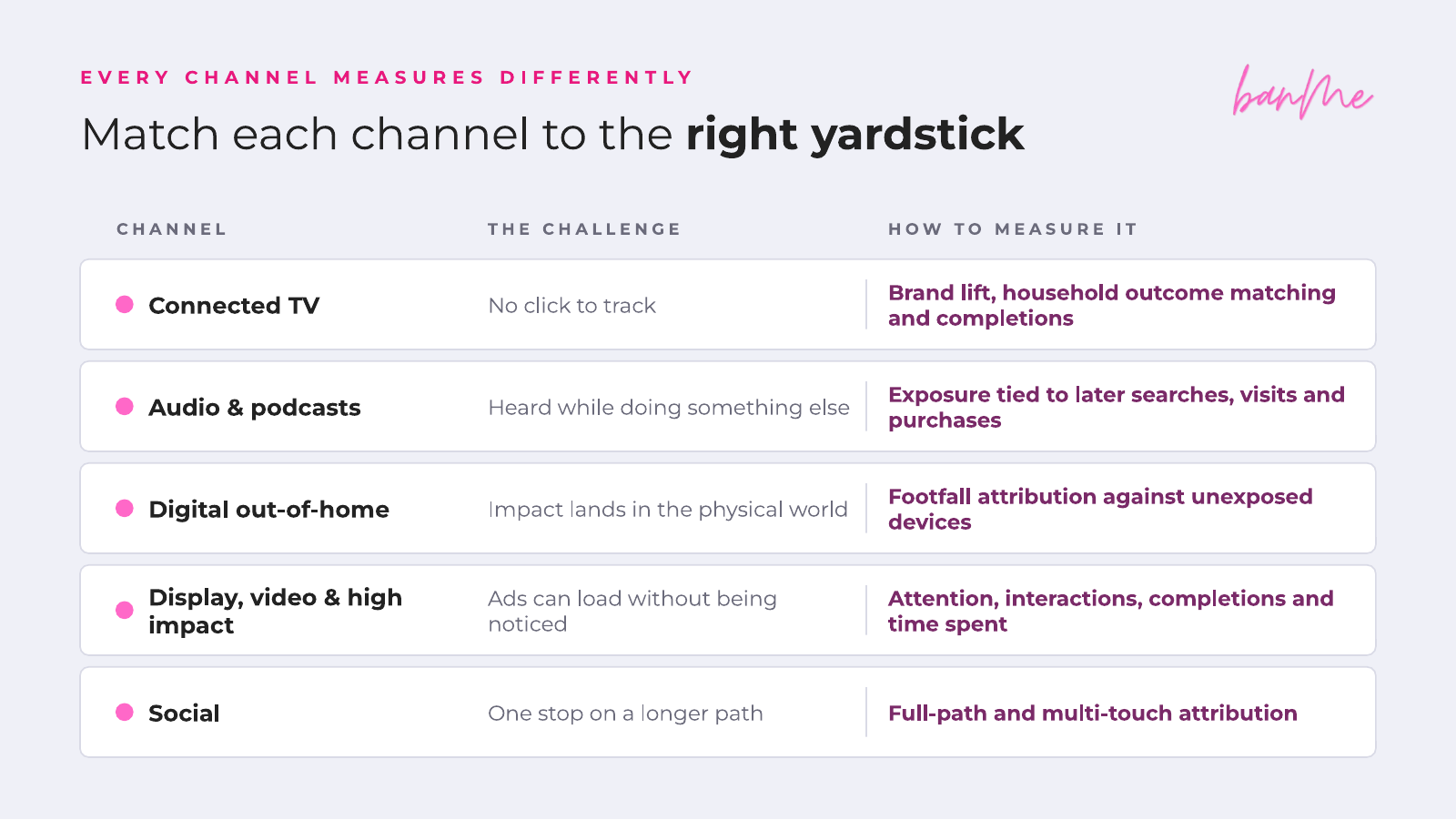
Treating all channels the same produces bad comparisons. Each one needs the right yardstick.
Connected TV. There is no click to track. The better questions are whether viewers remembered the brand, whether exposed households showed up on the site or in store, and whether they watched the full spot. Brand lift against a control group and household-level outcome matching answer those.
Audio and podcasts. People listen while doing something else. Impact shows up later as searches, site visits and purchases. Exposure data tied to downstream actions tells the real story.
Digital out-of-home. The screen lives in the physical world, so the outcome should too. Footfall attribution compares store and venue visits from exposed devices against similar devices that were not exposed.
Display, video and high impact. Viewability is the minimum bar. Attention, interactions, completions and time spent show whether the creative earned consideration or simply loaded on a page.
Social. Social is one stop on the path. It should be measured as part of the full journey rather than judged in isolation.
⚡ Viewability proves an ad could be seen. Attention and lift prove it mattered.
Why attribution alone falls short
Attribution tracks the touchpoints it can see and divides credit among them. That is useful for in-flight optimization. It cannot tell you whether the media caused the sale or simply stood nearby when it happened.
Incrementality testing fills that gap. By comparing exposed audiences against holdout groups, it isolates the lift the campaign actually produced. Brand lift studies do the same for perception. For long-range budget decisions across the full channel mix, marketing mix modeling adds a wider strategic view.
Each method answers a different question. The strongest programs use them together, with attribution guiding day-to-day decisions and incrementality keeping it honest. Adoption is moving fast. A July 2025 EMARKETER and TransUnion survey found that just over half of US brand and agency marketers already use incrementality testing.
⚡ Attribution tells you who was in the room. Incrementality tells you who closed the sale.
How banMe measures what media moves
banMe builds measurement into every campaign across four layers.
Brand impact and lift. We measure awareness, purchase consideration, creative preference and intent, with exposed audiences compared against a control group.
Verified outcomes. We track store visitation, footfall, sales lift, cart transfers and cart value, so results connect to real-world behavior and revenue.
Engagement and action. We report completions, interactions, time spent, viewability and attention to show how audiences responded to the creative.
Full-path attribution. We map every touchpoint across display, CTV, podcast and social rather than crediting only the last click. Multi-touch analysis shows which channels, formats and frequency combinations actually convert. CRM-matched conversions connect media exposure to online, offline and longer-cycle sales that pixels miss.
Incrementality testing sits across all four, separating the conversions media created from the ones it merely captured.
This work is powered by independent measurement and identity partners, including LiveRamp, comscore, adsquare, Measured and Samba TV. Independent verification matters when the goal is a number finance will accept.
Then the results go back to work. Insights feed the next audience, creative and media plan, and pre- and post-campaign AudienceIQ reports put those findings in audience terms. Every campaign makes the next one smarter.
Mistakes worth avoiding
Taking platform credit at face value. Treat platform-reported results as a starting point. Validate them with incrementality testing and actual sales.
Judging upper-funnel media on last click. CTV, audio and DOOH build demand that other channels capture. Last-click models will undervalue them every time.
Measuring channels in silos. Channel-by-channel optimization rarely adds up to better overall performance. Look at the full mix against business outcomes.
Confusing strong metrics with growth. High click-through rates and strong reported ROAS can come from demand that would have arrived anyway. Growth shows up as incremental revenue and new customers.
The bottom line
Measurement earns its budget when it changes a decision. The goal is a clear, trusted answer to what your media moved and a plan for what to do next.
banMe runs programmatic campaigns across CTV, audio, DOOH, display, high impact and social, with measurement built in from the start. If you want to prove what your media moves and put those insights to work, get in touch.