Stop Buying "Sports Fans": A Media Buyer's Playbook for the 2026–27 Live Sports Calendar
Live sports is still one of the few places you can buy mass attention in real time. The NFL, MLB, NHL, NBA and WNBA now run nearly back to back across the year, with a tentpole every few weeks.
The trouble is that the easy plan rarely holds. Premium CTV around the biggest games sells out early to sponsors, and a single "sports fans" segment is too broad to message well. The buyers who win the season plan around fans, moments and channel roles, not just the broadcast.
Here's how to build that plan for the 2026–27 calendar.
1. Plan for two kinds of fan, not one
Every big event pulls in two very different audiences, and they respond to different messages.
Diehards follow the analysis, fantasy lineups, box scores and team news before, during and after every game. They reward messaging that is specific and useful: performance, value, product benefits.
Moment fans show up for the watch party, the halftime show, the sold-out arena and the social buzz. They respond to identity, celebration and community.
The Super Bowl is the clearest example: football-first viewers sit next to people who are there mainly for the ads and halftime. Build creative and targeting for each group instead of averaging them into one.
2. Every game has three windows
A live game isn't one flight. It's three moments with different behavior, and each needs its own creative angle.
Pre-game: hype, predictions and analysis. Fans are planning where they'll watch, so this is the time to build consideration.
Game time: second-screen use and emotion peak. Decisions happen fast, which makes mobile the place to drive action.
Post-game: highlights, debates and recaps. Conversation and intent stay high after the final whistle.
Flight and rotate creative by window, and cap frequency tightly. Long seasons wear out a single message quickly.
3. Make CTV the amplifier, not the foundation
If your plan depends on buying more CTV around the Super Bowl or the World Series, you'll likely be boxed out or overpay. Sponsorships and priority placements take most of the premium inventory first.
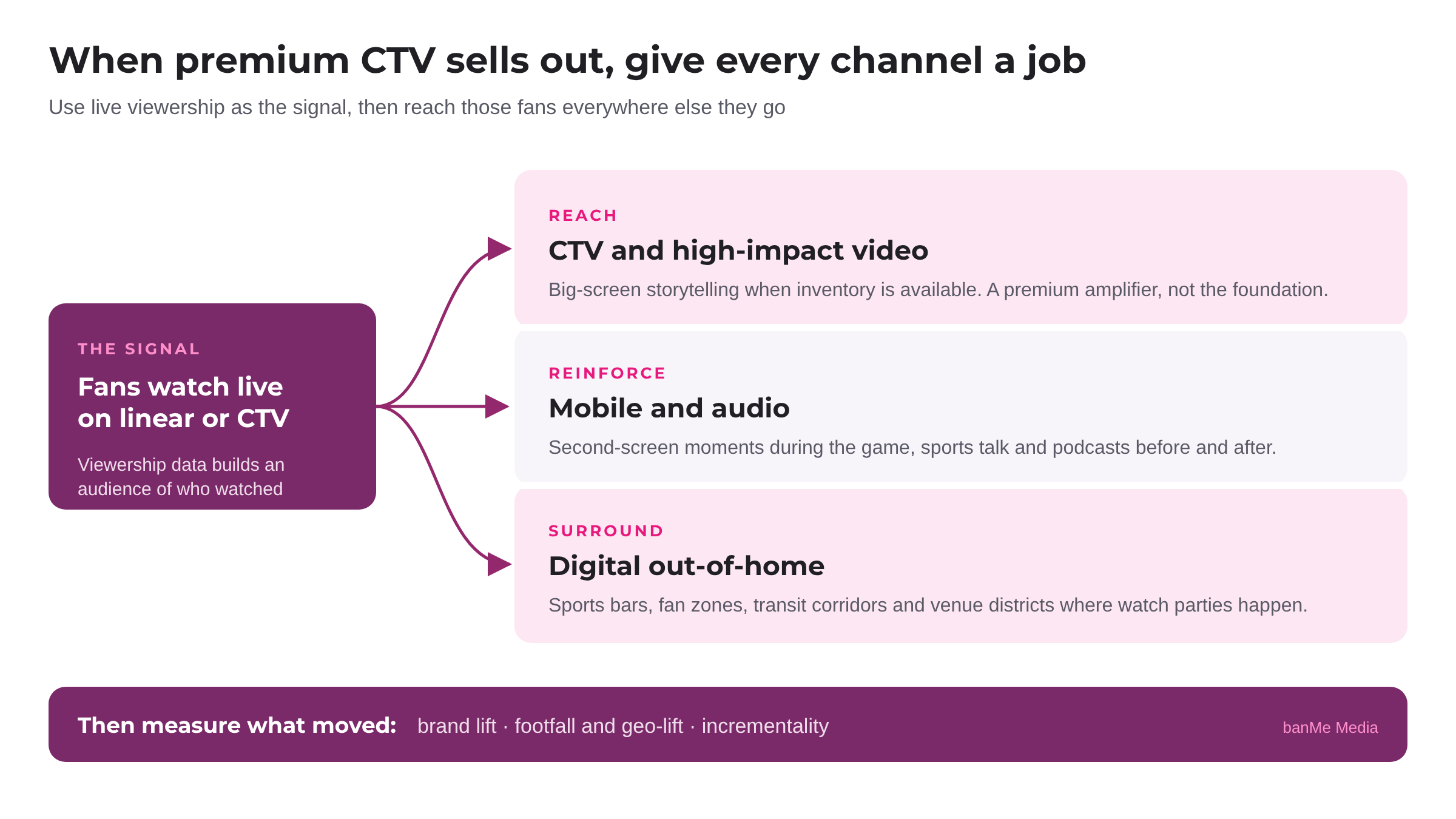
A sturdier approach treats live viewing as a signal. Viewership data shows who watched the game on linear or CTV, and you can reach those same fans on other channels without running in the broadcast itself. Then give each channel a clear job:
Reach: CTV and high-impact video for big-screen storytelling when inventory is available.
Reinforce: mobile for second-screen moments during the game, audio for sports talk and podcasts before and after.
Surround: DOOH in sports bars, fan zones, transit corridors and venue districts where watch parties happen.
AI contextual targeting helps here too. It reads what content means, not just keywords, so a tactical breakdown reaches diehards while a fashion or celebrity piece about the same game reaches moment fans.
4. Map the 2026–27 calendar now
The next 12 months stack five pro leagues plus March Madness and a tentpole almost every month. Seeing them together shows where audiences overlap and where to start planning
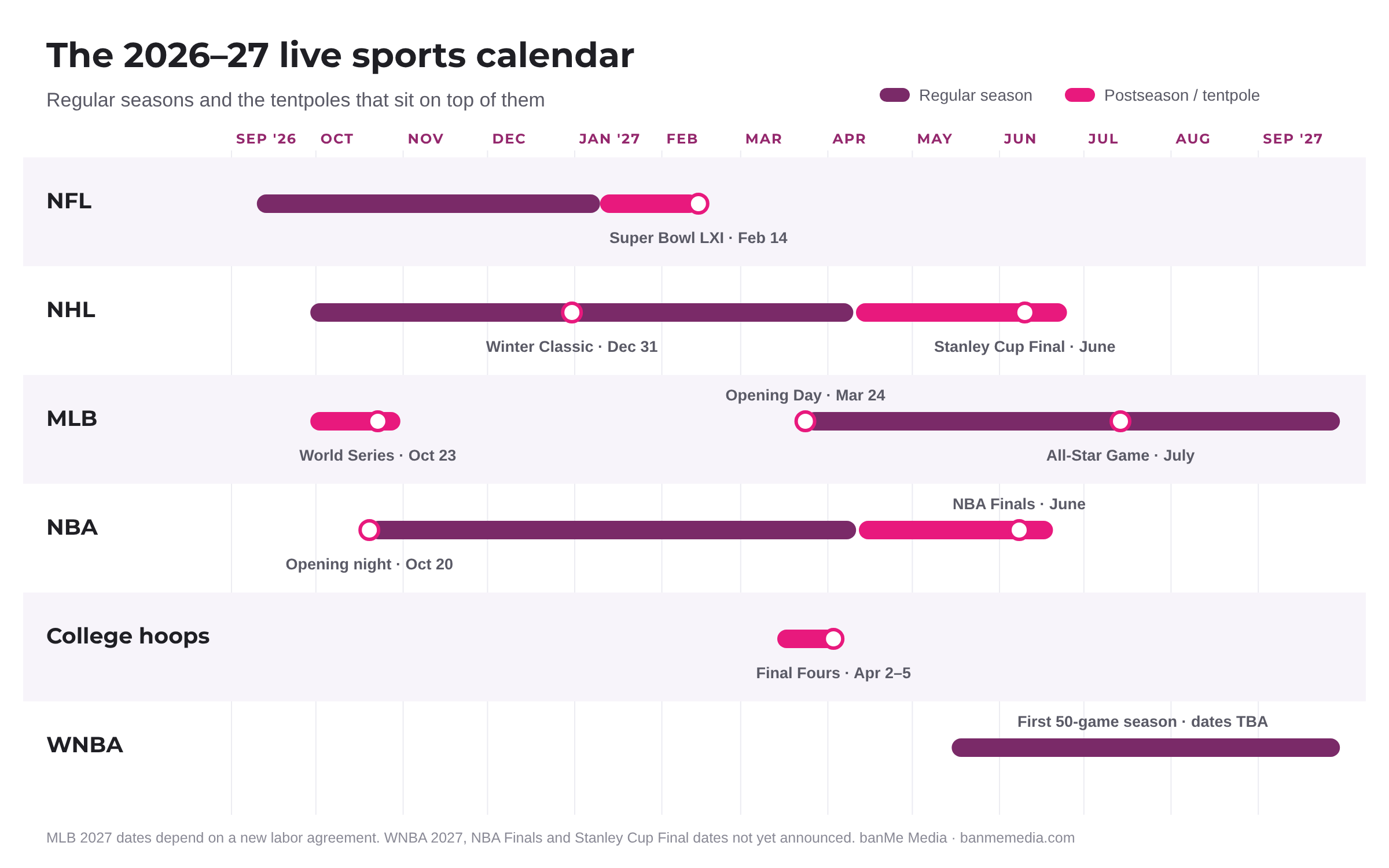
A few things stand out for buyers:
The fall overlap is crowded. NFL Sundays, the NHL opener on Sept. 29, NBA opening night on Oct. 20 and the MLB postseason all run at once. The World Series starts Oct. 23.
February belongs to football. Super Bowl LXI is Feb. 14, 2027, at SoFi Stadium in Los Angeles.
Spring stacks three moments. March Madness runs Mar. 14 to Apr. 5, with the women's Final Four in Columbus on Apr. 2 and 4 and the men's in Detroit on Apr. 3 and 5. MLB Opening Day falls in the middle, on Mar. 24. June then brings the NBA Finals and the Stanley Cup Final, with dates still to be announced.
Seasons are getting longer. The NHL plays 84 games this season, its longest since 1993–94, and the WNBA moves to a 50-game season in 2027.
Basketball now runs year-round. The NBA runs October through June, March Madness bridges the spring, and the WNBA carries live games from May through September. Give women's basketball its own line in the plan; its audience is one of the fastest growing in sports.
One caution: MLB's labor agreement expires Dec. 1, so 2027 dates could move. Build flexible flights for spring baseball.
5. Work backward from game day: 90, 60, 30
Tentpoles reward preparation. Start each one about 90 days out so cohorts, creative and measurement are set before CPMs peak.
90 days out – build the plan. Define fan cohorts, map the content environments that signal intent, pick watch-party markets for DOOH and set measurement baselines.
60 days out – pilot and learn. Test messaging by cohort in audio and mobile, run a DOOH pilot in a few markets and confirm what role CTV can realistically play.
30 days out – lock the game plan. Finalize flighting by game window, frequency caps and creative rotation, and line up every channel with game times.
6. Measure lift, not clicks
When CTV, audio and DOOH carry the plan, last-click reporting misses most of the impact. Measure what changed because people saw the ads.
Brand lift: awareness and consideration against a control group.
Footfall and geo-lift: store and venue visits in exposed markets compared with control markets, especially where DOOH surrounds watch parties.
Incrementality: conversions that would not have happened otherwise.
Read results during the season, not after. Shift budget toward the cohorts, windows and channel mixes that are moving outcomes while the games are still on.
The takeaway
The broadcast is only one piece of a live sports plan. Plan for two kinds of fan, three windows per game and a clear job for every channel. Then the season keeps working even when the biggest placements are spoken for.
banMe Media builds and activates live sports plans across CTV, video, audio, DOOH and high-impact formats, with brand lift, footfall and incrementality measurement included at no cost. If you're mapping your 2026–27 calendar, let's talk.